M203 20260314 Log and Triangle Practice
2. If $\log_{10} 2 = a$ and $\log_{10} 3 = b$, then $\log_{5} 12$ equals:
(A) $\dfrac{a + b}{1 + a}$ (B) $\dfrac{2a + b}{1 + a}$ (C) $\dfrac{a + 2b}{1 + a}$ (D) $\dfrac{2a + b}{1 - a}$ (E) $\dfrac{a + 2b}{1 - a}$
If $\log_2(\log_3(\log_4 x)) = \log_3(\log_4(\log_2 y)) = \log_4(\log_2(\log_3 z)) = 0$, then the sum $x + y + z$ is equal to
(A) $50$ (B) $58$ (C) $89$ (D) $111$ (E) $1296$
The set of $x$-values satisfying the equation $x^{\log_{10} x} = \frac{x^3}{100}$ consists of:
(A) $\frac{1}{10}$, only
(B) $10$, only
(C) $100$, only
(D) $10$ or $100$, only
(E) more than two real numbers.
5. If $y = (\log_{2} 3)(\log_{3} 4) \dots (\log_{n} [n + 1]) \dots (\log_{31} 32)$ then
(A) $4 < y < 5$
(B) $y = 5$
(C) $5 < y < 6$
(D) $y = 6$
(E) $6 < y < 7$
Suppose that $p$ and $q$ are positive numbers for which
$$\log_{9}(p) = \log_{12}(q) = \log_{16}(p + q).$$
What is the value of $q/p$?
1998 AHSME Problems/Problem 22
(A) $4/3$
(B) $\frac{1}{2}(1 + \sqrt{3})$
(C) $8/5$
(D) $\frac{1}{2}(1 + \sqrt{5})$
(E) $16/9$
9. What is the value of the expression
$$\frac{1}{\log_{2} 100!} + \frac{1}{\log_{3} 100!} + \frac{1}{\log_{4} 100!} + \dots + \frac{1}{\log_{100} 100!}?$$
(A) $0.01$
(B) $0.1$
(C) $1$
(D) $2$
(E) $10$
12. The set of all real numbers $x$ for which
$$\log_{2004}(\log_{2003}(\log_{2002}(\log_{2001} x)))$$
is defined is $\{x \mid x > c\}$. What is the value of $c$?
(2004 AMC 12A Problems/Problem 16)
(A) $0$
(B) $2001^{2002}$
(C) $2002^{2003}$
(D) $2003^{2004}$
(E) $2001^{2002^{2003}}$
13. For some real numbers $a$ and $b$, the equation
$$8x^3 + 4ax^2 + 2bx + a = 0$$
has three distinct positive roots. If the sum of the base-2 logarithms of the roots is 5, what is the value of $a$?
(A) $-256$
(B) $-64$
(C) $-8$
(D) $64$
(E) $256$
2011 AMC 10B Problems/Problem 24
A lattice point in an $xy$-coordinate system is any point $(x, y)$ where both $x$ and $y$ are integers. The graph of $y = mx +2$ passes through no lattice point with $0 < x \le 100$ for all $m$ such that $\frac{1}{2} < m < a$. What is the maximum possible value of $a$?
$\textbf{(A)}\ \frac{51}{101} \qquad\textbf{(B)}\ \frac{50}{99} \qquad\textbf{(C)}\ \frac{51}{100} \qquad\textbf{(D)}\ \frac{52}{101} \qquad\textbf{(E)}\ \frac{13}{25}$
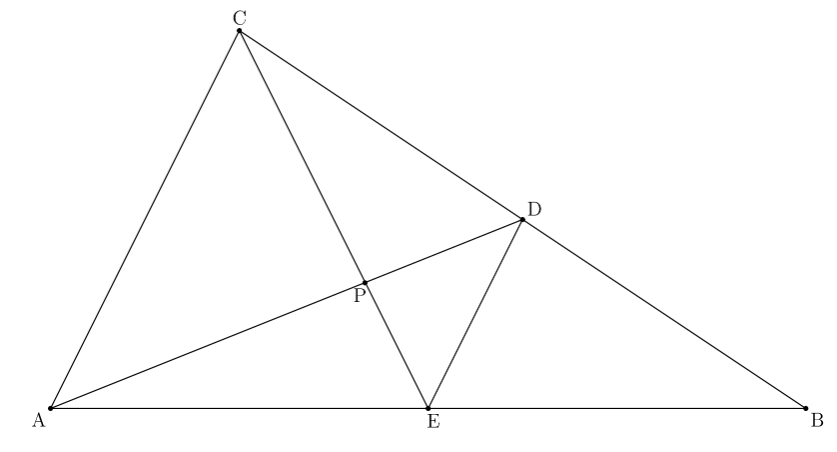
For $y=mx+2$ to not pass through any lattice points with $0 For each $d=2,\dots,100$, the smallest multiple of $1/d$ which exceeds $1/2$ is $1,\frac23,\frac34,\frac35,\dots,\frac{50}{98},\frac{50}{99},\frac{51}{100}$ respectively, and the smallest of these is $\boxed{\textbf{(B)}\frac{50}{99}}$. 2009 AMC 10A Problems/Problem 17 Rectangle $ABCD$ has $AB=4$ and $BC=3$. Segment $EF$ is constructed through $B$ so that $EF$ is perpendicular to $DB$, and $A$ and $C$ lie on $DE$ and $DF$, respectively. What is $EF$? $\mathrm{(A)}\ 9 \qquad \mathrm{(B)}\ 10 \qquad \mathrm{(C)}\ \frac {125}{12} \qquad \mathrm{(D)}\ \frac {103}{9} \qquad \mathrm{(E)}\ 12$ 2010 AMC 10A Problems/Problem 14 2010 AMC 12A Problems/Problem 8 Triangle $ABC$ has $AB=2 \cdot AC$. Let $D$ and $E$ be on $\overline{AB}$ and $\overline{BC}$, respectively, such that $\angle BAE = \angle ACD$. Let $F$ be the intersection of segments $AE$ and $CD$, and suppose that $\triangle CFE$ is equilateral. What is $\angle ACB$? $\textbf{(A)}\ 60^\circ \qquad \textbf{(B)}\ 75^\circ \qquad \textbf{(C)}\ 90^\circ \qquad \textbf{(D)}\ 105^\circ \qquad \textbf{(E)}\ 120^\circ$ 2013 AMC 10A Problems/Problem 15 Two sides of a triangle have lengths $10$ and $15$. The length of the altitude to the third side is the average of the lengths of the altitudes to the two given sides. How long is the third side? $\textbf{(A)}\ 6 \qquad\textbf{(B)}\ 8 \qquad\textbf{(C)}\ 9 \qquad\textbf{(D)}\ 12 \qquad\textbf{(E)}\ 18$ 2013 AMC 10B Problems/Problem 16 In triangle $ABC$, medians $AD$ and $CE$ intersect at $P$, $PE=1.5$, $PD=2$, and $DE=2.5$. What is the area of $AEDC$? $\textbf{(A) }13 \qquad \textbf{(B) }13.5 \qquad \textbf{(C) }14 \qquad \textbf{(D) }14.5 \qquad \textbf{(E) }15$ 2015 AMC 10A Problems/Problem 19 The isosceles right triangle $ABC$ has right angle at $C$ and area $12.5$. The rays trisecting $\angle ACB$ intersect $AB$ at $D$ and $E$. What is the area of $\bigtriangleup CDE$? $\textbf{(A) }\dfrac{5\sqrt{2}}{3}\qquad\textbf{(B) }\dfrac{50\sqrt{3}-75}{4}\qquad\textbf{(C) }\dfrac{15\sqrt{3}}{8}\qquad\textbf{(D) }\dfrac{50-25\sqrt{3}}{2}\qquad\textbf{(E) }\dfrac{25}{6}$ 2002 AMC 12A Problems/Problem 23 In triangle $ABC$, side $AC$ and the perpendicular bisector of $BC$ meet in point $D$, and $BD$ bisects $\angle ABC$. If $AD=9$ and $DC=7$, what is the area of triangle $ABD$? $\text{(A)}\ 14 \qquad \text{(B)}\ 21 \qquad \text{(C)}\ 28 \qquad \text{(D)}\ 14\sqrt5 \qquad \text{(E)}\ 28\sqrt5$ 2009 AMC 12A Problems/Problem 14 A triangle has vertices $(0,0)$, $(1,1)$, and $(6m,0)$, and the line $y = mx$ divides the triangle into two triangles of equal area. What is the sum of all possible values of $m$? $\textbf{A} - \!\frac {1}{3} \qquad \textbf{(B)} - \!\frac {1}{6} \qquad \textbf{(C)}\ \frac {1}{6} \qquad \textbf{(D)}\ \frac {1}{3} \qquad \textbf{(E)}\ \frac {1}{2}$